|
An Isolated TO-247 Package Significantly Lowers SiC MOSFET Temperature
As power electronics systems push toward higher efficiency, higher power density, and more compact form factors, thermal management has become a primary design constraint - not an afterthought. While silicon carbide (SiC) MOSFETs enable significant gains in switching performance and efficiency, their full potential is often limited by packaging - particularly in widely used formats like the TO-247.
 The traditional TO-247 package remains a workhorse across applications such as battery charging, renewable energy systems, and industrial drives due to its robust high-voltage handling and familiarity in design and manufacturing. However, its reliance on external electrical isolation materials (ceramic pads or other isolated thermal interface materials) introduces added thermal resistance, assembly complexity and manual labor, and long-term reliability concerns.
ISOMOS™ from Luminus APC fundamentally eliminates these constraints. By integrating a Direct Bonded Copper (DBC) ceramic isolation layer directly under the SiC die inside the TO-247 package, ISOMOS eliminates the need for external isolation materials altogether. The result is a shorter, more efficient thermal path from the SiC die to the heatsink - delivering dramatically improved heat transfer performance, better reliability, and reduced system cost.
At the core of this innovation is an Aluminum Nitride (AlN) submount, chosen for its exceptional thermal conductivity - significantly higher than traditional ceramic isolation materials - while still providing robust electrical isolation (2.5kV RMS, UL-compliant). This integrated approach not only improves thermal performance but also ensures greater consistency compared to external, variable, assembly-dependent TIM layers.
The impact is measurable and meaningful:
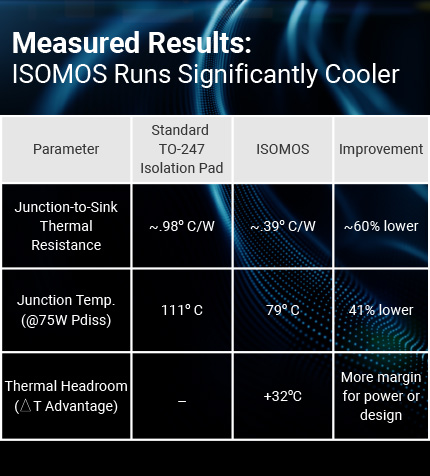
- Up to 60% reduction in junction-to-sink thermal resistance
- Approximately 41% lower junction temperatures under comparable operating conditions
- Increased thermal headroom, enabling higher output power or reduced system size
These improvements translate directly into system-level advantages. Designers can reduce heatsink size, lower cooling requirements, or increase power density without adding complexity or cost. In many cases, fewer parallel devices are required, simplifying circuit design and reducing bill-of-materials costs.
Just as important, ISOMOS improves reliability where it matters most. Lower and more stable junction temperatures reduce thermal stress on the device, extending operational lifetime. The elimination of external pads also removes common failure points such as material degradation, pump-out, misalignment, and torque variability during assembly. For high-reliability applications - especially in automotive and industrial environments - this translates to improved durability, reduced maintenance, and stronger long-term performance.
From a manufacturing perspective, ISOMOS simplifies assembly by removing multiple manual steps associated with isolation materials. This enables more consistent, automation-friendly production while reducing labor costs and variability in thermal performance from unit to unit.
In short, ISOMOS extends the life of the TO-247 package into the next generation of power electronics. It allows engineers to capture the full benefits of SiC technology - higher efficiency, higher power density, and improved reliability - without the need to transition to more complex and expensive module-based solutions.
Visit us at PCIM 2026, Stand 5-354, or email apc-e@luminus.com to see the demo and learn more about this and other SiC products from Luminus APC.
|


